





What is Ambisonics?
A recording of the sound around one point, not the feeds for one set of speakers. A decoder works out the feeds later, for whatever you are listening on.
Ambisonics is also called scene-based audio. It sits beside channel beds and objects.
Reach for it when nobody knows the speakers in advance. You meet it in 360° and VR video, games, installations and recordings of whole spaces.
SoThe file is the scene. Only the decoder knows about speakers, and it comes last.
What are the four channels?
Four microphone patterns at one point: W is an omni, and X, Y and Z are figure-8s facing front, left and up.
This is first order, the simplest kind: four channels.
W hears everything equally. X, Y and Z each hear one axis, and nothing from the sides of it.
If you know mid/side, this is M/S on three axes. W is the mid; X, Y and Z are three sides.
The channels hold the direction, not the speakers, so you can’t listen to them raw. Solo X and a sound ducks as it passes your sides.
SoMix the four in different amounts and you get a mic pointing any way you like. That is the heart of what a decoder does.
How does a sound get into them?
By panning. An encoder writes each mono track into all four channels at once, in amounts set by its direction.
TryDrag the sound round behind you, then raise it.NoticeW never moves. X flips as the sound passes behind you, Y flips as it crosses to the right, and Z only wakes up when the sound leaves ear height.
The bars run in the order a file stores them: W, Y, Z, X.
Every track gets its own encoder, and they all feed one bus. The bus needs as many channels as the order: 4 for first order.
Treat the channels as one thing. EQ, compress or mute one on its own and you bend the whole picture.
SoThe direction lives in the balance between the four channels. Process them together, never one on its own.
How does it get out to speakers and headphones?
A decoder turns the channels into feeds for one set of speakers, or for headphones. It runs last, so the same file plays on any rig.
On speakers, the decoder aims a virtual mic at each speaker’s direction and sends it what that mic hears.
On headphones, it makes a binaural pair instead.
Keep the encoder and the decoder on the same order and the same convention, AmbiX to AmbiX.
SoThe decoder is the only thing that knows what you are listening on. Change the output and nothing upstream changes.
What does “order” mean?
Resolution. Each higher order keeps the first four channels and adds finer patterns from the same point: not more microphones, more detail.
Order N uses (N + 1)² channels: 4 at first order, 9 at second, 16 at third.
At first order, front and back get confused and nearby sounds merge. Higher orders let the decoder aim a narrower virtual mic.
A third-order file still holds the first-order channels. A first-order decoder just reads the first four.
SoFirst order is blurry: front and back get confused. Third order is where it gets good.
Where does the microphone fit in?
A mic with four capsules in a tetrahedron captures a real space. Its raw output is A-format; a converter turns that into the four channels, B-format.
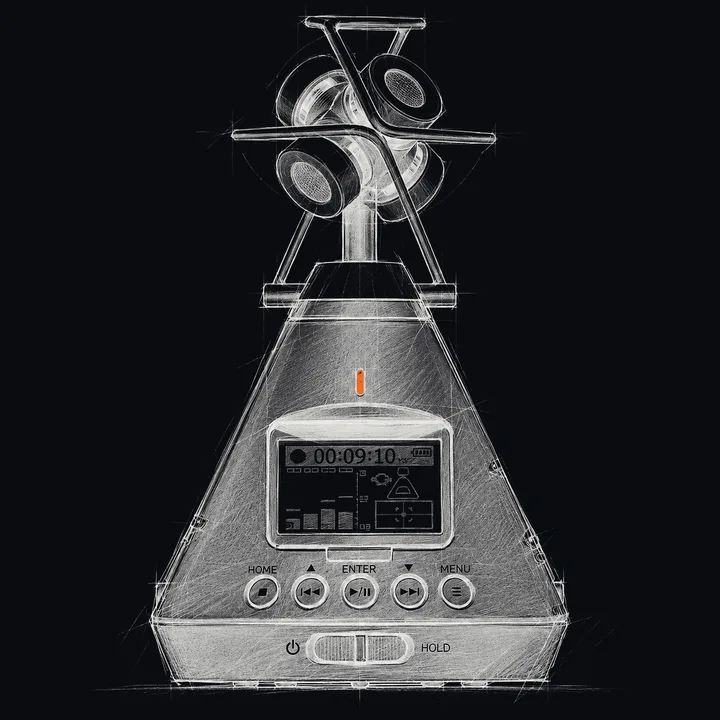
Our pick to start: Zoom H3-VR
Four matched capsules in a tetrahedron give you first order, in a recorder that fits a pocket and runs on two AA batteries.
It converts A-format to B-format on the recorder and writes AmbiX, so the file goes straight into your session, or into Aro.
Bigger arrays, such as the Zylia ZM-1 and the Eigenmike, reach higher orders. Each comes with its maker’s own software.
SoConvert A-format once, then treat B-format like any other audio.
AmbiX or FuMa: which file is this?
Every ambisonic file looks like a plain multichannel WAV. Find out its order, whether it is A or B, its channel order and its levels. The name AmbiX answers the last three at once.
| Convention | Channel order | Levels | Where you meet it |
|---|---|---|---|
| AmbiX | W, Y, Z, X | No channel peaks above W | YouTube, most DAWs and plug-ins. Use this. |
| FuMa | W, X, Y, Z | W held 3 dB down | Older files, the original Soundfield mics, some plug-ins. |
Read an AmbiX file as FuMa and three channels land in the wrong slots. Left comes out in front, and front comes out above you.
To turn a first-order FuMa file into AmbiX, reorder the channels to W, Y, Z, X and raise W by 3 dB. Most decoders, Aro included, do it for you once you tell them which one the file is.
Masters can carry it too. An ADM BWF master has a place for scene-based audio, and so does IAMF.
SoUse AmbiX for all new work, label your files, and tell the decoder what it is reading.
What do I need to start?
A first-order recorder such as the Zoom H3-VR, something that can decode what it records, and headphones.
 AroOur Ambisonic decoder for the Mac, in beta. It opens ambisonic files from first to seventh order, AmbiX or FuMa, and decodes them to any layout up to 9.1.6, or to Orbit Binaural on headphones.
 OrbitOpens ADM BWF masters and decodes their beds, objects and HOA, up to third order, on speakers or headphones.
 Orbit ProEverything in Orbit, plus export from ADM BWF to IAMF.
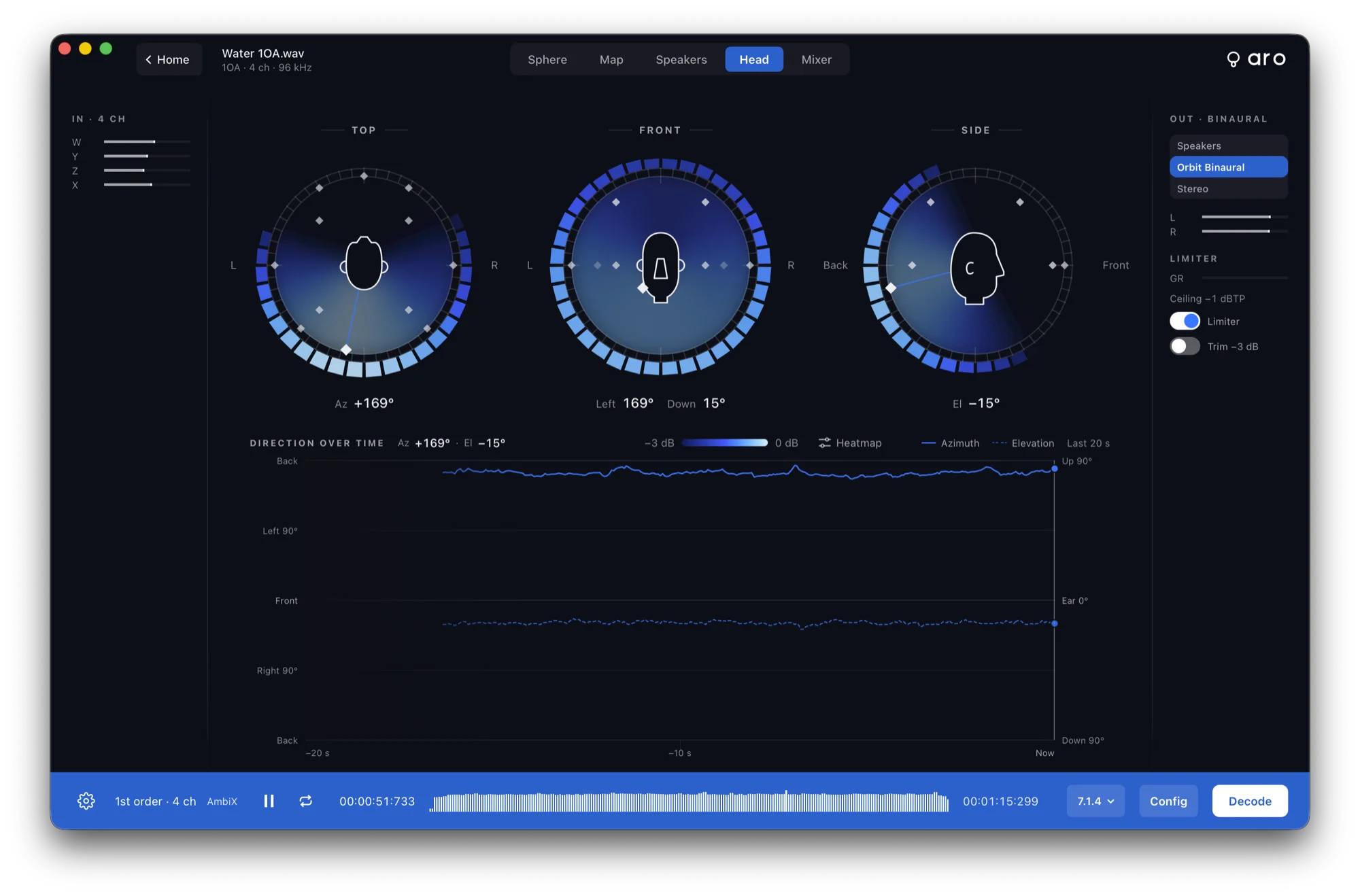
If it sounds wrong
- It sounds mono, or everything sits in the middle.
- You are hearing W on its own. The decoder is not in the chain, or its output is going to the wrong place.
- Front is on the left. Left is above me.
- Wrong channel order. Tell the decoder whether the file is AmbiX or FuMa.
- It is vague, and sounds come from behind when they should be in front.
- That is first order doing its best. Record or mix at a higher order.
Other tools work too. The sources below list the IEM Plug-in Suite from Graz, and ICST Zurich’s Ambisonics 101 and FAQ.
SoRecord first order, decode it to headphones, and listen before you mix anything.
Five questions before you go
Question 1 of 5Glossary
- Scene-based audio
- Audio stored as a sound field around one point rather than as speaker feeds. Ambisonics is the example.
- W, X, Y, Z
- The four first-order channels: omni, front–back, left–right and up–down. These are Ambisonics’ own axes (X forward, Y left, Z up), not the ADM coordinates used for object positions elsewhere on this site.
- Order
- How detailed the directional information is. Order N in full 3D uses (N+1)² channels.
- FOA / HOA
- First-order ambisonics (4 channels, also written 1OA) and higher-order ambisonics (order 2 and up: 2OA, 3OA and so on).
- A-format
- The raw signals from a mic’s capsules, before conversion. Only the tetrahedral, first-order kind is a shared standard; higher-order arrays use their makers’ own layouts.
- B-format
- The ambisonic channels themselves. What you record, mix and decode.
- AmbiX
- The common exchange format: channels in ACN order (first order runs W, Y, Z, X) at SN3D levels, where no channel peaks above W.
- FuMa
- The older Furse-Malham convention: W, X, Y, Z order, with W 3 dB down.
- Encoder, decoder
- An encoder writes a sound into the channels at a direction: a panner. A decoder turns the channels into feeds for one specific set of speakers or headphones.
- Binaural
- Two-channel audio for headphones that recreates how sound reaches each ear, so it seems to come from around you.
Further reading
Start with Into the Soundfield, the University of Oxford's documentary project on Michael Gerzon and the people who invented this. A film, interviews with Peter Craven, Paul Hodges and Tony Faulkner, and Stephen Thornton's diaries from the experiments. Freely available online, and the best account of where ambisonics came from.
- M. A. Gerzon, "Periphony: With-Height Sound Reproduction," J. Audio Eng. Soc., vol. 21, no. 1, pp. 2–10, 1973. AES E-Library
- F. Zotter and M. Frank, Ambisonics: A Practical 3D Audio Theory for Recording, Studio Production, Sound Reinforcement, and Virtual Reality, Springer Topics in Signal Processing, vol. 19, 2019. Open access. Springer
- C. Nachbar, F. Zotter, E. Deleflie and A. Sontacchi, "AmbiX – A Suggested Ambisonics Format," 3rd International Symposium on Ambisonics and Spherical Acoustics, Lexington, KY, June 2011. Semantic Scholar
- YouTube Help, "Use spatial audio in 360-degree and VR videos." support.google.com
- Zoom, "H3-VR Handy Recorder." zoomcorp.com
- Zylia, microphone arrays. zylia.co · mh acoustics, "Eigenmike em64." eigenmike.com
- Institute of Electronic Music and Acoustics, Graz, "IEM Plug-in Suite." plugins.iem.at · ICST Zurich, "Ambisonics 101" and FAQ. ambisonics.ch
Written by the people who make Orbit.