




Learn Spatial Audio, Starting With Ambisonics
A new free education section on orbitspatial.io. The first guide is an interactive Beginner's Guide to Ambisonics: spin the pickup patterns, drag a sound around a listener and hear it decoded to headphones, then see how four ordinary studio mics record a first-order scene.
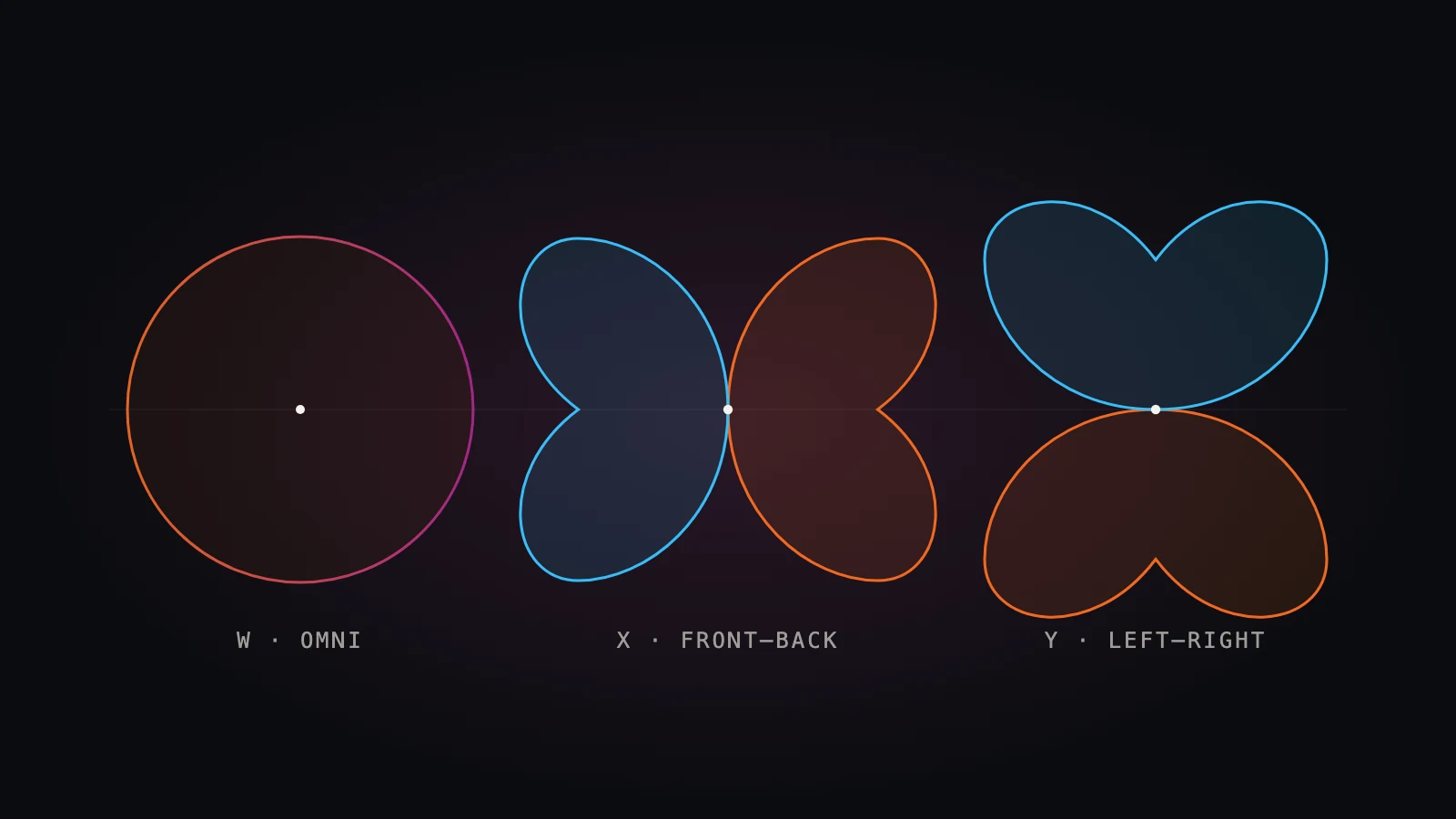
We have opened a new part of the site: Learn spatial audio. Plain-language guides to how immersive sound is captured, mixed, delivered and checked. Free, with nothing to sign up for, written by the people who make Orbit.
The first guide is live today: A Beginner’s Guide to Ambisonics.
Why start with Ambisonics
Most of what goes wrong in an immersive master comes from a misunderstanding earlier in the chain. Ambisonics is a good place to start because it forces the one idea everything else rests on: describe the sound around a point, not the feeds for one particular set of speakers. Once that lands, beds, objects, binaural renders and fold-downs all make more sense.
It is also everywhere now. 360° and VR video carry it, game engines and VR headsets decode it on the fly, and a growing range of microphones record it directly. If you have ever been handed a four-channel file labelled W, Y, Z, X and wondered what to do with it, this guide is for you.
What is in the guide
It is built to be played with rather than read straight through. Fifteen minutes, no prior knowledge needed, shaped as eight questions a newcomer asks, in the order they need answering: what Ambisonics really is, with a sound you can drag around a listener and hear decoded; what the four channels are; where the microphone fits in; what “order” means; how to tell an AmbiX file from a FuMa one, and what a mis-read file sounds like; how tracks get in and sound gets out; what to do when it sounds mono; and what you need to start.
There is a glossary at the end, and a reading list that goes back to Gerzon’s 1973 paper for anyone who wants the maths.
What is coming
The hub lays out a syllabus of three paths: Foundations, Formats and delivery, and Loudness and QC. Twelve guides in all, from what spatial audio is and isn’t, through reading an ADM BWF master and IAMF and Eclipsa Audio™, to loudness for immersive to ITU-R BS.1770-5 and a QC checklist for an immersive master.
Only Ambisonics is written so far. The rest are marked as coming soon, and we would rather publish each one properly than promise a date. New guides go out in the Orbit newsletter alongside release news; the sign-up is in the footer of every page.
A note on accuracy
These guides carry our name, so they have to be right. Before this one went live it was checked against the primary sources, including Gerzon’s original work, Zotter and Frank’s open-access Ambisonics textbook, the AmbiX format paper and ITU-R BS.2051, and the maths behind every interactive panel was verified independently. If you find something we have got wrong, or explained badly, tell us. The address is in the footer.